Famous Faces. Not So Famous Brands.
Look at enough Indian advertising and something slightly peculiar begins to happen. Different companies, different products, different categories, and yet an awful lot of the same people.
In 2025, Mahendra Singh Dhoni appeared in television advertising for 59 brands. Shah Rukh Khan appeared for 41. Amitabh Bachchan for 38. And that is television alone.
This is not an argument against celebrity endorsements. I say that having led strategy on at least five advertising campaigns that eventually starred Dhoni. Celebrities can be enormously useful. They can make an unknown company familiar, make a smaller brand feel bigger, lend credibility, alter perceptions and create momentum much faster than most brands could manage on their own.
The interesting question is not whether celebrity endorsements work. They clearly can.
It is what, precisely, the brand is buying.
What a famous face actually buys
A celebrity enters an advertisement carrying something most brands desperately want: accumulated memory.
People already know them. They may trust them, admire them, find them interesting or simply pay attention when they appear. Years of films, cricket matches, interviews, controversies and cultural presence have done much of the expensive work before the brand enters the picture.
That value is very real. Kroll estimated the combined brand value of India's top 25 celebrities at about $2 billion in 2025. Shah Rukh Khan was valued at $177.9 million; Dhoni at $115.3 million.
The brand gets access to an asset somebody else spent years building.
The complication is that access is not ownership.
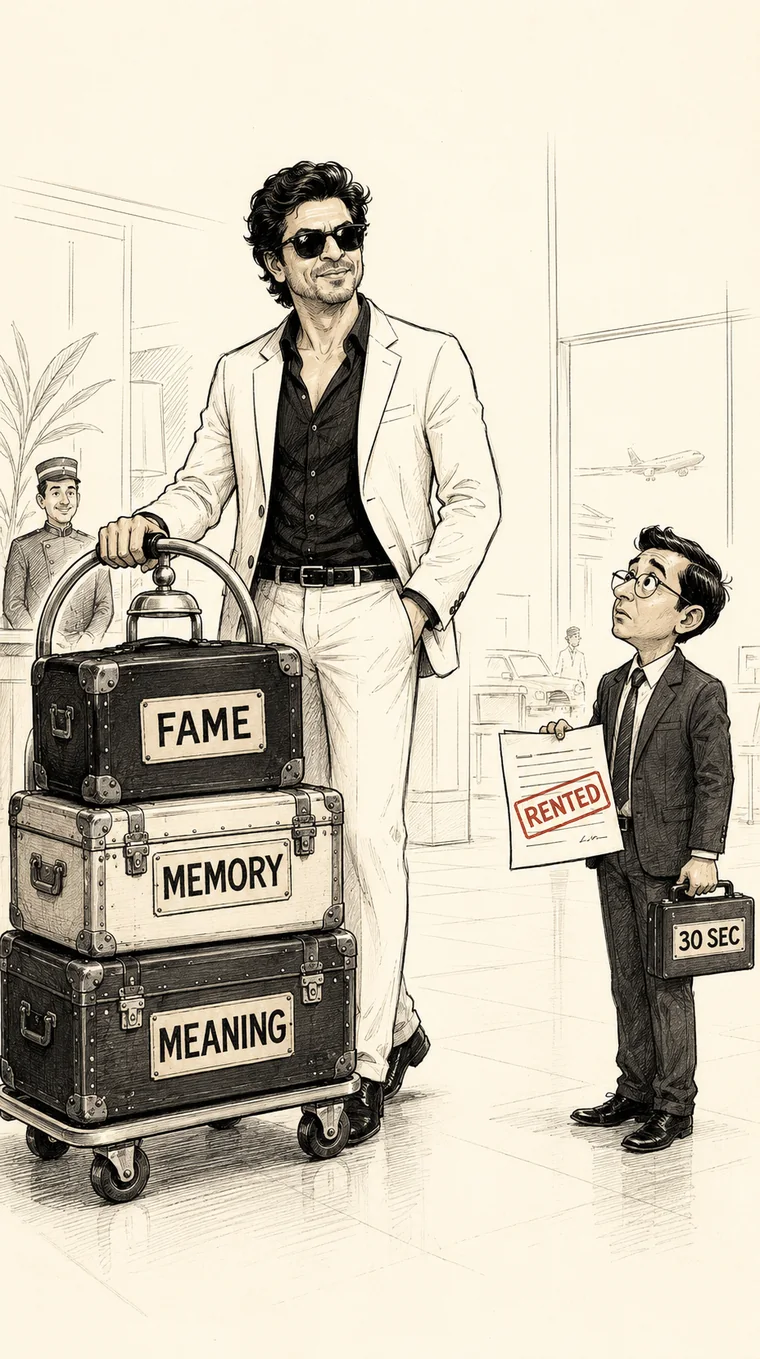
When the endorsement contract ends, the celebrity takes the fame with them. What matters to the business is what has transferred in the opposite direction: meaning, memory, preference or some association that continues to belong to the brand.
This becomes harder when the same celebrity occupies several adjacent mental territories.
Dhoni has appeared with TVS Eurogrip tyres, Gulf Pride engine oil, DRiV aftermarket parts and EMotorad e-bikes. Each choice is individually defensible. His association with motorcycles makes the logic fairly obvious.
Collectively, however, the consumer is being asked to perform rather more sophisticated filing than the marketing departments involved may realise.
The contract may say “category exclusive”. Consumer memory never signed the contract.
Several companies can pay for the same famous face. They cannot jointly decide which brand the consumer remembers when that face appears.
That is why the useful measure of celebrity endorsement is not simply reach, attention or even recall of the advertisement. The harder question is whether the advertising builds an association the brand can eventually retrieve without needing the celebrity standing beside it.
Fame can generate attention. Brand building still has to decide where that attention gets deposited.
Fit is not enough
Brands often ask whether a celebrity "fits" the brand. It sounds sensible because it is sensible. It is also incomplete.
There is persona fit: does what this person represents support what the brand wants to say? There is category fit: does the association make intuitive sense for the product? And then there is memory fit: does thinking of the celebrity retrieve the brand?
Ajay Devgn and Vimal are a useful case.
The category fit is hardly self-evident. The persona fit is open to debate. The memory fit is formidable.
Years of repetition, consistent branding and the difficult-to-ignore finger-to-the-eye device have created an association strong enough that Ajay Devgn and Vimal can retrieve each other almost automatically.
More recently, Maharashtra's Food and Drug Administration issued show-cause notices relating to Vimal Elaichi advertising, arguing that the communication creates an association with Vimal Pan Masala and could amount to indirect promotion of the prohibited product.
Whatever one thinks of the category, it demonstrates an important branding point: celebrity fit does not always have to be found. It can be built.
But building it requires consistency and an idea in which the famous person has a function beyond being famous.
Rahul Dravid's "Indiranagar ka Gunda" work for CRED remains such a good example because the idea used what audiences already believed about Dravid. Calm, measured, dependable Dravid suddenly behaving like a road-raging lunatic was funny because it violated an existing piece of cultural knowledge.
CRED did not merely hire his fame. It used his persona as raw material.
That gives marketers a useful casting test. Replace the celebrity's name in the script with "Famous Cricketer" or "Famous Actor". If the idea survives perfectly well, perhaps the brand does not need that particular celebrity at all.
It may simply be buying visibility.
Celebrity carry can also travel in less convenient directions. A famous person brings the whole person into the relationship: reputation, opinions, behaviour, good decisions and spectacularly bad ones. An unknown model can misbehave too. The difference is that almost nobody notices.
The greater the fame, the greater the potential carry. The strategic question is therefore not merely how much attention the celebrity creates, but where that attention eventually lands.
The problem with visible value
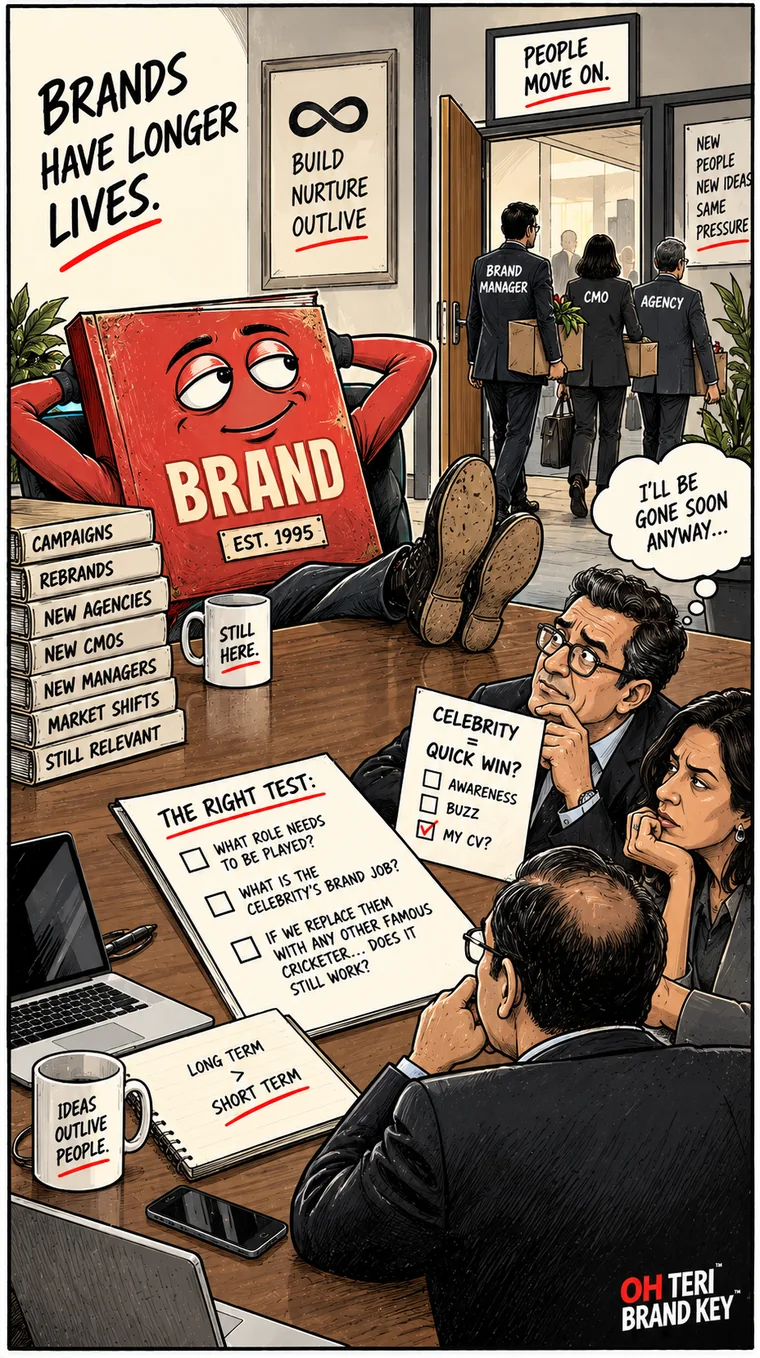
There is another reason celebrity endorsements are seductive, and it has less to do with consumers than with organisations.
They produce visible value quickly.
A company announces a famous ambassador and immediately there is PR, trade coverage, dealer conversation, internal excitement and leadership attention. The agency has a high-profile campaign. The marketing team has one too. Almost everybody can point to something that happened.
Compare that with building distinctiveness, preference, memory or pricing power. Those rewards are slower, harder to photograph and frequently arrive years after the presentation that proposed them.
That creates an uncomfortable mismatch.
The brand may need to exist for thirty years. The brand manager may move in three. The CMO may leave. The agency may change.
There is no need to assume cynical intent. Nobody has to sit in a conference room plotting to hire a celebrity because it will look good on a CV. Organisational incentives can shape decisions without anybody behaving badly.
The benefits of celebrity endorsement are often immediate and visible. The cost of weak brand ownership may reveal itself much later, when the people who approved the decision have moved on.
The brand has not.
Which is why the celebrity conversation should begin before somebody asks who is available and what they cost.
Does the brand actually need a celebrity? What business or communication problem are they solving? Is the brand buying stature, credibility, familiarity or cultural reach? What might it be surrendering in product attention, distinctiveness or creative territory? What does this particular person make possible that another famous person could not? Who else is already borrowing the same associations?
And when the contract ends, what stays behind?
That may be the most important question on the brief.
Because a brand should not hire a celebrity merely to make the advertising famous.
It should know what the celebrity is going to make the brand famous for.
Fame can be rented.
Memory has to be owned.
Famous Faces. Not So Famous Brands.
The video episode expands the argument with campaign examples and the full celebrity checklist.
Sources / Campaigns Referenced
TAM AdEx — Celebrity-Led TV Advertising: Key Trends & Insights from 2025
Kroll — India Celebrity Brand Valuation 2025
WPP Media — Sporting Nation 2025
Maharashtra Food and Drug Administration action concerning Vimal Elaichi advertising
CRED × Rahul Dravid — “Indiranagar ka Gunda”
TVS Eurogrip, Gulf Pride, DRiV and EMotorad celebrity campaigns referenced in the accompanying episode research