How Brands Become Interchangeable.
Every brand wants to be distinctive.
This is usually stated with considerable conviction in conference rooms occupied by people who have been educated at similar institutions, worked at many of the same companies, hired from overlapping talent pools, read the same trend reports, attended the same conferences and, increasingly, asked the same artificial intelligence what Gen Z wants.
The agencies across the table are not immune. People move between them. Planning disciplines share models. Creative departments watch the same award shows, directors’ reels and cultural references. Production companies work across competing brands. Platforms impose identical formats. Research asks broadly familiar questions.
Then, somewhere during the third round of creative development, somebody looks at the work and says:
“Could we make this more distinctive?”
It is a reasonable question. It may simply have arrived rather late.
There is an old observation about modern businesses becoming increasingly similar because they employ similar people, doing similar jobs, using similar methods and producing similar things. The thought predates much of today’s marketing technology, which makes it more interesting rather than less. Businesses now have access to more knowledge, more data, more expertise and more examples of best practice than at any point in history.
They also have access to almost exactly the same knowledge, data, expertise and examples of best practice as everyone else.
That is the sea of sameness. Advertising merely makes it visible.
The machinery of sameness
Creative departments tend to get blamed because the final symptom appears on a screen. But by the time a creative team receives a brief, quite a lot of difference may already have been processed out of the problem.
Brand language has become remarkably standardised. A business wants to be bold. Another wants to be authentic. A third needs greater relevance among younger consumers. Somebody needs premiumisation. Somebody else has discovered purpose. Everyone would like to be culturally relevant.
Occasionally one gets the impression that the world economy is managed by a single, unusually energetic brand manager.
There is nothing wrong with these ambitions. Most are perfectly sensible. The problem is that they are rarely specific enough to create strategic advantage.
If a problem statement could comfortably be placed on the first slide of six competitors’ presentations, it places an extraordinary burden on the work downstream to produce something proprietary.
Marketing has also become very good at creating processes for dealing with uncertainty. Frameworks are part of that.
I have used enough pyramids, funnels, positioning models and archetypes to have no ideological objection to any of them. They can clarify a messy problem and force useful decisions. Workshops can help too, Post-its included. The problem starts when completing the framework begins to feel like completing the strategy.
A model can organise a problem. It cannot be allowed to manufacture the answer.
Run genuinely different businesses through the same sequence of questions, definitions, workshops and evaluation criteria and the differences do not vanish. Something subtler happens. The range of possible answers narrows.
The inputs remain different. The processing system is not.
This is one reason cookie-cutter models can produce cookie-cutter tendencies without anyone involved behaving like a cookie cutter.
The same applies to best practice.
Best practice is one of business’s great achievements. It is how organisations learn rather than repeatedly discovering fire for themselves. If somebody has found a more efficient way to manage a supply chain, analyse customer behaviour or reduce waste, imitation is usually a sign of intelligence.
But best practice has a side effect. Once an advantage has been documented, taught, benchmarked, packaged into a conference presentation and uploaded to LinkedIn, it is no longer particularly difficult for competitors to acquire.
Best practice raises the floor. It does not necessarily raise your ceiling above everyone else’s.
Advertising has become spectacularly efficient at distributing creative knowledge. Work from São Paulo, Seoul or Stockholm can appear on a strategist’s screen in Mumbai before lunch. Cannes winners are dissected immediately. Pinterest, Instagram, TikTok, YouTube, Behance and directors’ reels provide a reference library that previous generations of advertising people could barely have imagined.
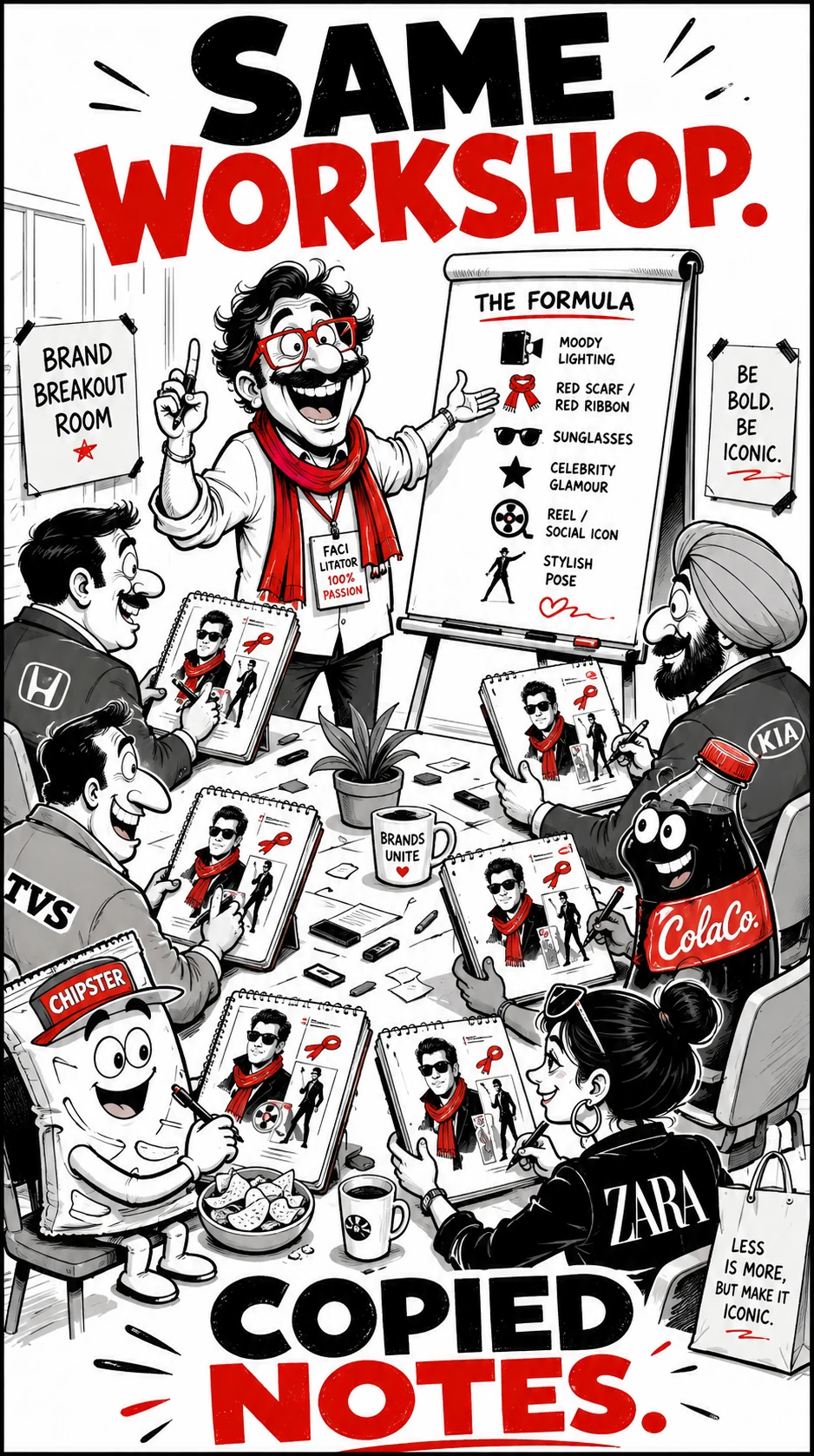
We have never had greater access to inspiration. We may also never have seen inspiration become convention quite so quickly.
A visual language can move from surprising to admired to familiar to mildly exhausting in remarkably little time.
Generative AI adds another layer. It does not create this problem, but it certainly does not make the reference pool less shared. Millions of people can now interrogate overlapping models trained on overlapping cultural material and then wonder why some of the answers rhyme.
None of this means people are copying one another. That is the important bit.
Quite often, nobody needs to.
References play their part too.
“Can you show me something like what you mean?” is one of the most reasonable requests in advertising.
So the team finds a film that explains the lighting. Another that explains the movement. A fashion shoot communicates the casting. A music video helps everybody understand the attitude.
The unfamiliar idea is now much easier to approve. It is also a little more familiar.
References are useful precisely because they reduce uncertainty. That is why agencies use them and clients ask for them. The danger is not the reference itself. It is the gravitational pull created by repeatedly needing the new thing to resemble an old thing before anybody is comfortable making it.
Approval systems have similar effects.
The piece of work that can be mentally categorised is usually easier to discuss than the one nobody quite knows what to compare with. Research tends to be more comfortable evaluating familiar forms. Production teams naturally know how to execute established techniques. Senior management has seen evidence that familiar approaches have worked before.
All of this is individually rational. Collectively, it can produce an extraordinary machine for making the unfamiliar slightly more familiar at every stage.
Nobody enters the process intending to make generic advertising. Everyone simply follows the process.
That may be part of the problem.
This is also why the Mahindra Thar ROXX and Hero Xoom films interested me.
They are very different products. Their advertising was produced by two capable, distinct agencies working independently. There is no need to invoke copying, imitation or some elaborate theory involving a stolen mood board.
Parts of the films nevertheless occupy surprisingly similar visual and cultural territory. That is precisely what makes the example useful.
Competent people can independently arrive at similar signals when they are drawing from the same wider vocabulary of attitude, style, cool, cinematic confidence and contemporary relevance.
Different briefs. Different teams. Similar cultural water.
We pulled the two films apart in Episode 1 of OhTBK.
Same Same But Branded
Thar ROXX vs Hero Xoom Ads. Watch it and you will get the point.
Watch on YouTube →Then forget those two campaigns for a moment. They are evidence of the phenomenon, not the subject of this article.
When familiarity becomes interchangeability
Some convergence is necessary.
Categories develop codes because people need to understand communication quickly.
Luxury has codes. Technology has codes. Banking has codes. Automotive advertising has quite a few. Youth has codes. Masculinity has codes. Premium appears to have accumulated enough codes to require its own customs department.
These signals help audiences decode what they are seeing.
A bank does not necessarily become more distinctive by making advertising that resembles an underground rave and refusing to mention money.
Difference for the sake of difference is just eccentricity with an invoice.
The more useful distinction is between category codes, cultural codes and brand codes.
Category codes help people understand what sort of thing this is. Cultural codes help communication feel current and socially legible. Brand codes help people know whose communication it is.
Good advertising can use all three. Often it should.
Trouble begins when category and cultural codes perform nearly all the work while the brand arrives at the end with its logo.
The advertisement may be beautiful. It may test well. It may be completely defensible against the brief. It may also belong more strongly to the category than to the brand paying for it.
This matters because brands are built partly in memory.
Over time, a name, shape, colour, sound, phrase, character, visual treatment, product behaviour or particular attitude becomes associated with one business.
Previous communication begins helping future communication. Recognition becomes faster. New messages have somewhere to land. Investment compounds.
At least that is the theory.
In practice, organisations are often surprisingly enthusiastic about repeatedly withdrawing from their own memory account.
A new marketing leader arrives. A new agency is appointed. A new campaign platform is required. The brand gets a fresh visual world, a fresh proposition, a fresh tone of voice, perhaps a fresh sonic identity and, if everybody has been particularly productive, an entirely new purpose.
The work may be excellent.
Five years later the brand possesses an impressive collection of campaigns with very little connective tissue between them.
Advertising has been made. Memory has not necessarily been accumulated.
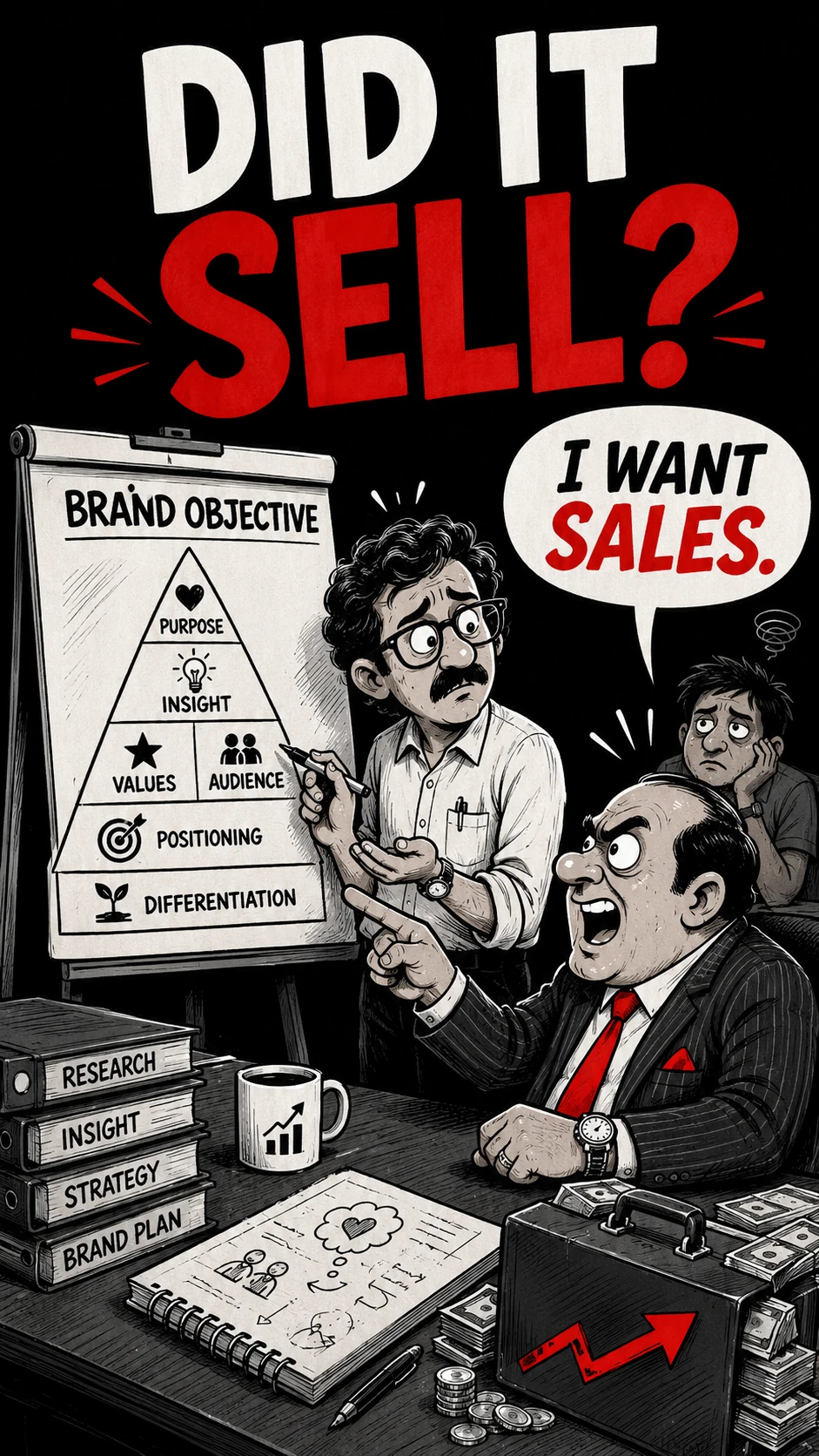
That is when sameness stops being an aesthetic complaint and becomes a commercial issue.
If people have weak proprietary associations with a brand, something else must work harder at the point of choice.
Price can do it. Promotion can do it. Distribution can do it. Media weight can do it. Convenience can do it.
None is famous for being free.
There is therefore a business consequence to interchangeability. The more substitutable the brand becomes in memory, the more other parts of the commercial system may have to compensate.
The substitution test
There is a useful way to pressure-test communication before everybody becomes too attached to the animatic.
It involves four questions.
Remove the logo.
How much of the work still feels as though it could only belong to your brand?
This is not a research guessing game. Recognition is not the only issue. The question is how much proprietary ownership remains once the easiest identifier disappears.
Replace your logo with your largest competitor’s.
Does the idea become absurd, or does it continue functioning rather comfortably?
If the competitor could run it next month after changing the pack shot and one line of copy, you may have created a strong category idea wearing your name badge.
Remove the obvious category cues.
What is left?
A particular tone? A character? A behaviour? A sound? A phrase? A visual grammar? Something in the way the product is dramatised? If very little remains, the communication may be borrowing most of its meaning from elsewhere.
Put the last five campaigns on one wall.
This is usually the interesting one.
Do they feel like different chapters written by the same author? Or like five talented strangers who happened to share a Dropbox account?
Distinctiveness is longitudinal. One unusual campaign can attract attention. A system of recognisable memory built over years can become an asset.
Brands sometimes confuse those two achievements.
Escaping the current
The answer is not to throw away frameworks, stop looking at references, reject category conventions and instruct the creative department to produce something nobody has ever seen before.
That would certainly increase originality. It might also produce some magnificently unusable advertising.
The aim is not permanent novelty. It is ownership.
That begins with being much more precise about the problem.
“Reach younger consumers” is not a particularly proprietary problem. Neither is “build relevance”, “drive consideration” or “become more premium”.
What exactly prevents growth? What do people currently remember about the brand? Which associations are strong? Which are weak? Where does the business have credibility? Where is it pretending? What is the competitor structurally better at? What behaviour needs to change? What does the brand possess that others cannot easily borrow?
Specific problems create useful constraints. Generic problems generally require inspiration to do all the differentiating.
Brands also need to become more conscious about which codes they are borrowing and which they intend to own.
There is nothing wrong with using the grammar of a category. There is nothing wrong with participating in contemporary culture.
But if every powerful signal in the communication comes from the category or culture, the brand itself is contributing remarkably little to its own advertising.
That should make someone uncomfortable.
Frameworks still have a role.
Use the pyramid if it clarifies the problem. Use the archetype if it helps sharpen character. Run the workshop if the right people need to think together. Just resist the temptation to treat a completed template as evidence that strategy has occurred.
The better question at each stage is whether the process has revealed something particular to this business, or merely organised what everybody already knows.
Creative development can also use a deliberate convergence check.
Not another 46-page framework. Just a pause.
What is the obvious solution to this brief? What is everyone else in the category currently doing? Which references are appearing repeatedly? Which cultural shorthand have we reached for because it genuinely belongs to the brand, and which because everybody recognises it?
Where exactly does this route become ours?
That last question matters.
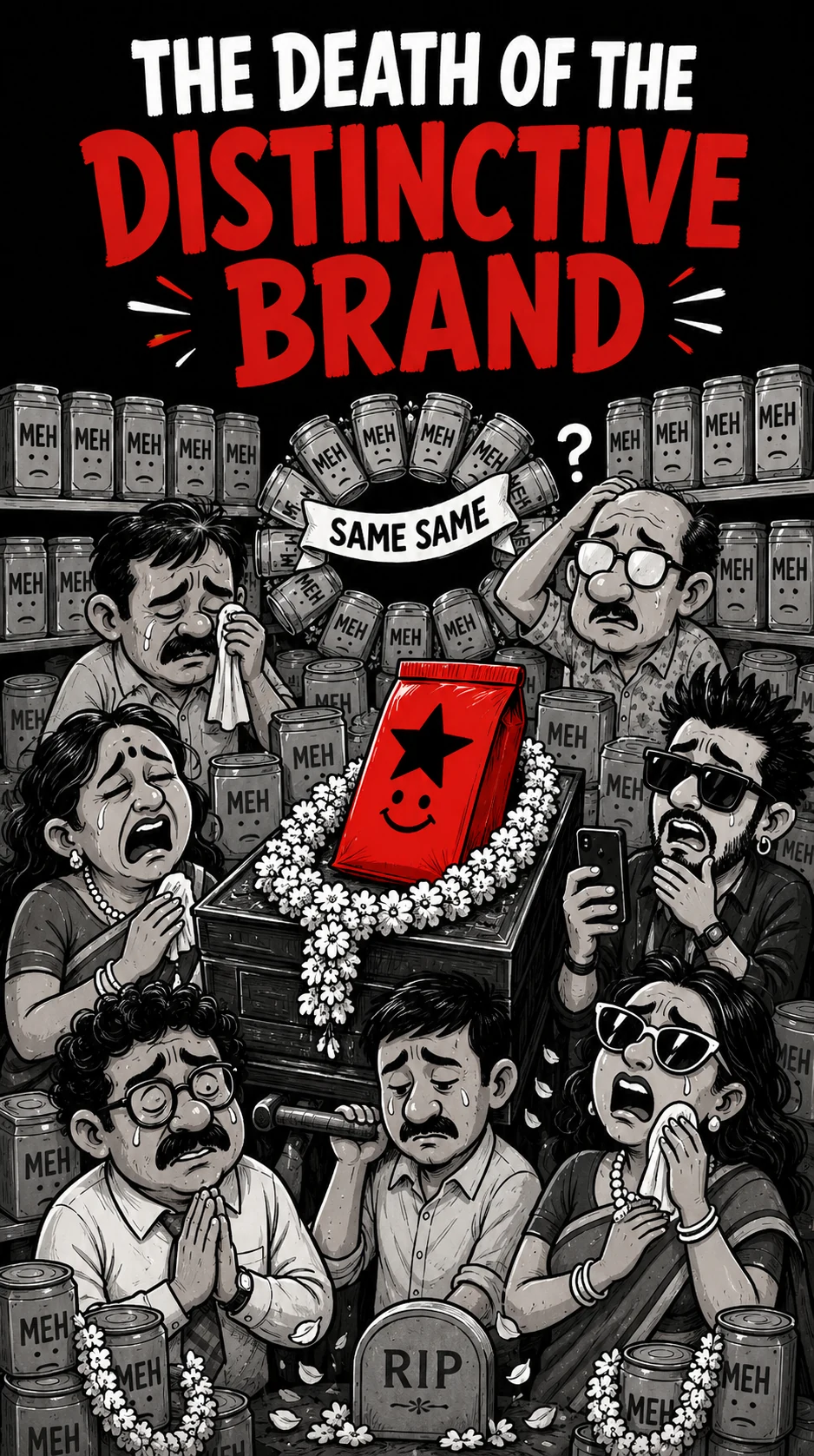
Consistency is often misunderstood here.
The alternative to constant reinvention is not making the same advertisement forever.
Strong brands develop a grammar rather than a template. A grammar allows endless sentences while preserving recognisable structure.
The brand might have recurring ways of using humour, framing stories, dramatising products, speaking, behaving, selecting music, using characters or occupying culture.
Executions can change considerably. Ownership remains. That is very different from running one campaign format until the agency starts hiding from the brief.
The same principle should apply across time.
A new CMO or agency should not automatically trigger a memory wipe. Some assets deserve to be killed. Others deserve to be developed for another decade. The difficult part is knowing which is which.
“Fresh” is an aesthetic judgement. Accumulated memory is an economic asset. They should not be valued as though they are the same thing.
Difference is getting harder to create.
In many industries, functional advantages can be copied quickly. Technology spreads. Suppliers overlap. Talent moves. Data sources converge. Management practices improve across entire categories.
That is mostly progress.
But it makes the things competitors cannot easily appropriate more valuable.
Advertising does not need to reject everything familiar. It simply needs to remember what familiarity is for.
Category conventions can help people understand you. Cultural codes can help you remain contemporary. Best practice can make you better. Frameworks can help you think.
None of them necessarily makes you distinct.
The sea of sameness is unlikely to disappear. Too many perfectly sensible forces keep feeding it.
So the job is not to drain the sea. It is to make sure the brand does not dissolve into it.
Because if several years of advertising vanish the moment somebody removes the logo, perhaps the answer is not to make the logo bigger.
Perhaps the brand underneath it needed to become bigger first.