
The Prompt Is Not the Problem.
At Cannes this year, much of advertising’s AI conversation circled the visible spectacle: generated films, synthetic talent, machine-written copy and the increasingly urgent question of what happens to creative jobs. Sir Martin Sorrell chose a less glamorous target. In a July interview with ET BrandEquity, he argued that the more consequential disruption lies in agency economics. His formulation was blunt: “Time and materials is not the right model.”
Advertising has traditionally made effort unusually easy to invoice. Bigger teams, longer production schedules, more rounds, more assets and more hours all produced something a procurement spreadsheet could recognise. A better decision was harder to price. AI is now removing some of the labour that made the old equation feel natural. Work that took days can take hours; work that took a team can sometimes be done by two people with good tools and better judgment. A machine does not need fifteen hours spent staring thoughtfully through glass.
This would be easier to dismiss as another technology panic if the underlying advertising market were collapsing. WPP Media’s June 2026 India forecast puts advertising revenue at about ₹2 trillion this year, up 8.8%, with long-term growth expected to be driven by digital, AI adoption, e-commerce and quick commerce. Yet Hindustan Times reported in June that agencies have been operating on margins of roughly 3% to 5% for years, while an increasing share of digital money runs through Google, Meta, e-commerce and quick-commerce systems in which agencies do not necessarily own the transaction, the data or even the operating advantage.
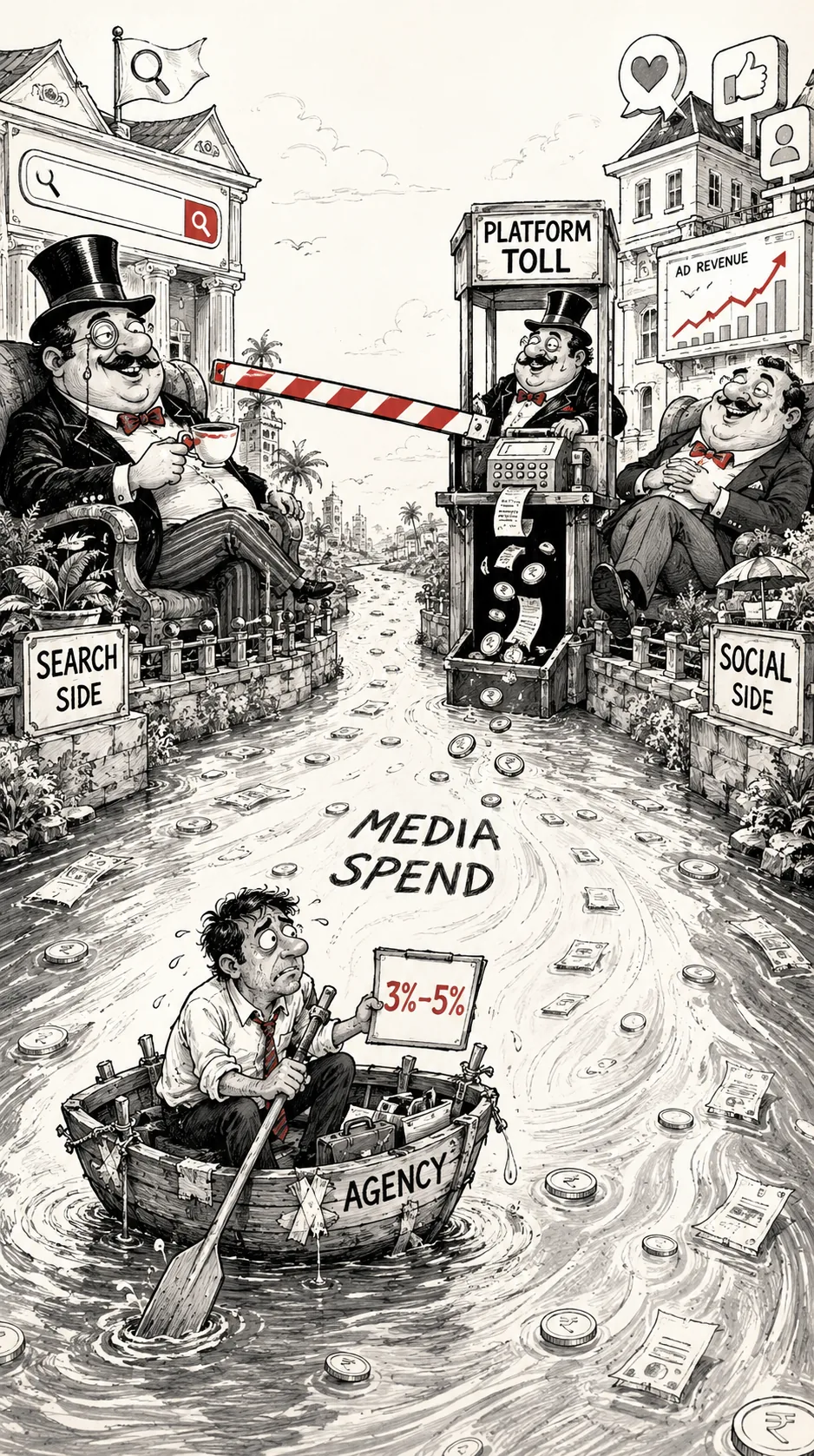
The contradiction is more revealing than the panic: advertising expenditure can grow while the agency’s claim on that expenditure weakens. AI did not create this problem. It arrived after years of fee pressure, undercutting and the steady conversion of agency services into comparable units of labour. When one supplier offers work worth a hundred for sixty, the immediate winner is the client. When enough suppliers do it for long enough, sixty becomes the market’s memory of what the work was worth. Technology then arrives and performs part of the sixty for six.
That is also the argument at the centre of the latest OhTBK episode, The Prompt Is Not the Problem. The film takes the longer route through agency pricing, media, production and the parts of the business AI is beginning to strip of cost and mystique. The question running through it is less whether machines can make advertising than what agencies are still being paid to contribute when they can.
Defending the disappearing work is probably the wrong battle. McKinsey’s June study of the emerging “agentic advertising economy” describes planning, buying, reporting and creative production as among the agency activities most exposed to AI. Its conclusion is less that agencies vanish than that their value has to move from execution towards orchestration: designing systems, interpreting signals, governing automated decisions and proving business outcomes. The research is US-based, so it should not be mistaken for an Indian market forecast. The structural pressure is nevertheless familiar.
Clients are moving too. Research from the World Federation of Advertisers found that 93% of global in-house agency leaders surveyed planned further AI investment over the following 12 to 24 months. Forty percent were already reporting faster content production. Access to the means of production is becoming a weaker reason to hire an external agency.
That is uncomfortable but useful. Routine execution should become cheaper when technology makes it cheaper. There is no persuasive economic theory under which a client should keep paying for twenty hours because the task used to require twenty. Efficiency has to benefit the buyer as well as the seller. Cheaper execution, however, does not make every other form of value cheaper.
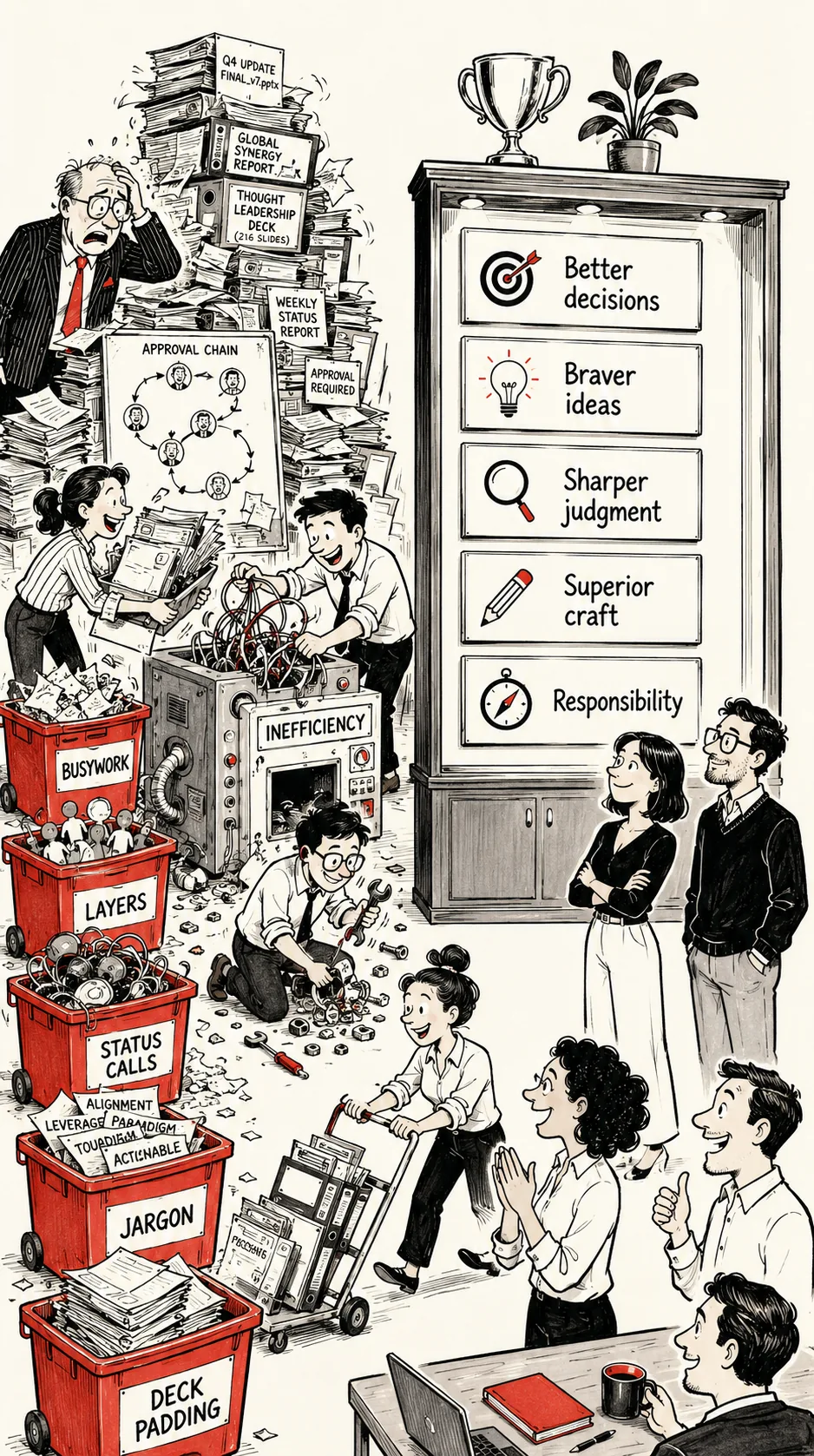
The scarce part of good advertising was never typing the line, resizing the banner or moving the bid. It was understanding which problem mattered, deciding what the brand could credibly say, recognising when a short-term conversion trick would create a longer-term brand cost, knowing which idea was ordinary and which one deserved money behind it, and applying enough craft to turn the decision into something people might notice. AI can participate in all of those tasks. It can generate options at extraordinary speed. What it cannot do is accept commercial responsibility for choosing the wrong one.
Accountability matters, but it is only one part of the premium. Judgment without craft can produce an intelligent strategy nobody remembers. Craft without judgment can produce beautiful irrelevance. Original ideas without commercial understanding are an expensive hobby. The agency worth paying for combines these things, then takes responsibility for the recommendation and its consequences.
Pricing that contribution is harder than counting hours. Sorrell expects agencies to move towards outputs, subscriptions or usage-based models; McKinsey points to outcome-linked pricing among the approaches being explored. None is a universal answer. Pure outcome-based remuneration sounds wonderfully modern until sales move because of distribution, pricing, product quality, the economy or a competitor’s spectacular own goal. Agencies should not be paid like roulette tables for variables they do not control.
The likely answer is less theatrical: commercial models that separate cheapening execution from valuable contribution, and reward agencies for the things they can genuinely influence. A retainer can still make sense when it buys continuity, context and senior attention. A project fee can make sense when the output is clear. Performance components can make sense when cause and effect can be measured without fiction. The model matters less than the principle behind it.
For decades, agencies could bundle labour, access, craft, judgment and responsibility into one invoice. AI is starting to unbundle them. Labour is becoming easier to automate and benchmark. Access to sophisticated tools is becoming less exclusive. Judgment, context, originality, craft and responsibility remain difficult to standardise, which is inconvenient for procurement and rather encouraging for genuinely good agencies.
The prompt is therefore a distraction. The harder question is what remains on the invoice when the machine has removed the hours that were easiest to count. The agencies that survive will not be the ones that prove people can still do the work. They will be the ones that prove which part of the work was worth buying from them in the first place.